When I was a kid,, back to school clothes were a big deal. Mom and I would go to Pueblo and do all the stores. I remember going through the stacks of shirts at KMart, and pants at Germer’s and hitting the mall. I’d get everyday stuff and usually a new dress for picture day, and new shoes, and a lot of times a new coat too. I’d lay all my clothes out on my bed and take off the tags. Mom would always wash them first to get off the store cooties, but I’d hang up my first day outfit in the closet because I wanted it to have that fresh, crisp newness to it. Even after I started going to Catholic school and wore a uniform, Mom and I’d still go back to school shopping and I’d get shoes and some clothes for dances and weekends. When I started student teaching, Mom went with me to Haven’s downtown and bought me a blue dress that is still hanging in my closet, because I can’t let go of that memory.
At some point in my life, I gave up going back to school shopping for myself. I had to buy school clothes for my kids and pay bills and a mortgage and shopping for myself just became totally unnecessary. Plus as an art teacher, all my clothes had paint on them anyway. Last year, when I left the art classsroom, I knew I needed some new clothes, so I went thrift store shopping with my daughter. She sat me down and asked me about what I liked. Here’s how that conversation went.
“I like soft things.”
“Good, you should touch the clothes, because texture is the most important because that’s what you said first. “
“I also hate sleeves, high waists, floral prints, animal prints, plaid, and button down blouses. And collars. I hate collars on shirts. ”
She stared at me, and then she sighed and said, “Fine. Stay here and I will get you some clothes.” And I have to say, she did a fair job because everytime I wear the clothes she picked out, people compliment me. Clothes got fun again.
The school district does a big kick off where all the employees come together on the first day. It’s a time for introductions, information, and inspiration. My first kick off was in 1995, when I student taught. One of my elementary teachers greeted me that day with a hug and welcomed me to the district. I used to enjoy the first day, but over time my joy has eroded. When my parents died, my HR director told me that I could just do what was comfortable for me. I skipped the kick-off. As my trauma continued, walking into the crowd at the beginning of the year became like its own little source of trauma.
I was completely overwhelmed about everything about going back to school, especially the kick-off. I am afraid of having panic attacks again. I am afraid of the conversations of why I left, why I am back. I am afraid of meeting new people and being in a new building and managing all the balls that get thrown everyday. I am afraid that I am too shattered to put myself together and be everything I need to be to do this job. My new principal had asked us to wear purple to the first day kick off. So I was also was worried that I didn’t have anything to wear. A trip to the mall seemed like the way to handle it all–instead of overthinking back to school, I overthought purple.
For the record, I don’t hate purple, but I have opinions about it that aren’t necessarily flattering and it is not my go to color. I decided I wanted to wear purple camouflage pants to school the first day. Since I have to touch the clothes first, on line shopping isn’t my first choice. I set off on a pretty impossible task to find purple camo pants locally. Of course, I couldn’t. And after checking an Army supply store and taking in the rows of camouflage clothes and posters of soldiers and weapons, I decided that camo could be perceived as symbolically representing going into battle and that is not the attitude I want to convey. I did say I overthought this, didn’t I?
Next I tried a Western boutique that I have been in before. It has a classy, but comfortable vibe and the salespeople are nice. I bought a very nice blouse with an almost watercolor looking flower print, even though I HATE button downs and floral prints. I also bought a purple tank top and some gray soft brushed denim pants with purple flowers embroidered on the pockets. A whole outfit. I could have been done, but I wanted shoes. And I needed make up and a new lanyard. So I went to the mall.
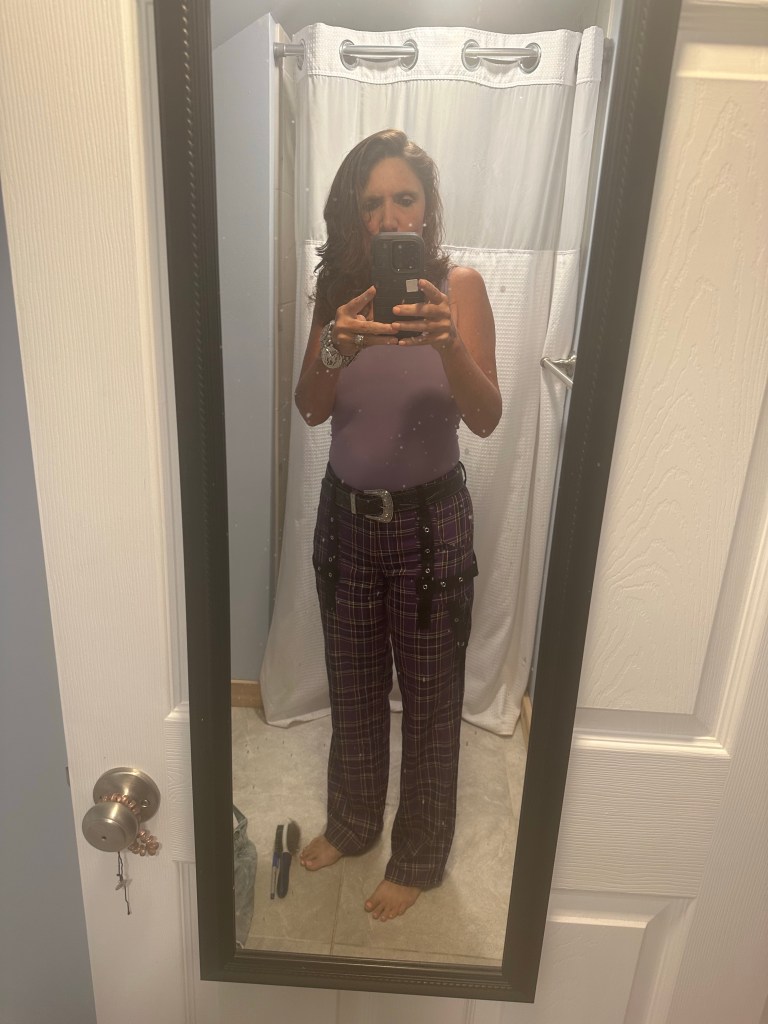
I was still thinking about purple camo, so I went into Hot Topic when I got to the mall. On the sales rack was one pair of purple plaid pants. I spotted them immediately and they were my size, so I tried them on. I could see with the right shirt and belt, that I could pull them off, even though the phrase “clown pants” went through my head. Perfect for school spirit day. I felt a little ridiculous, buying pants at a store for edgy teens. But I felt like I was ready for school as far as purple went.
The morning of the kick off, I put on my new flower purple shirt, and brushed denim pants and looked at myself in the mirror. Flowers. Buttons. A collar. I couldn’t. I took it off. I looked in my closet and found my Prince T-shirt. It sort of worked with the gray pants, but I hate the texture of it and I didn’t know if wearing a rock music t-shirt was a good first day look. I didn’t want to look too casual, like I don’t care about the first day of school. So I took the T-shirt off and looked in my closet for a purple flowy top that I remembered I had. Technically it’s more of a purple sage. Okay, so gray. It also has spaghetti straps. I didn’t want bra straps peeking out, so I tried some brand new silicone breast petals that I have never worn. I read the directions and sort of wondered what sort of gravitational force held them to the skin. I also wondered if I wore them to school if they’d fall off. Maybe they’d come lose with sweat and slide down my body and fall to the floor in front of everyone. Oh great. I had just given myself something else to overthink. I tried on the new purple tank top, with a real bra and realized that the clown pants might work. I put them on. I looked like Donny Osmond. Flashy, yet wholesome.
Because I had spent so much time getting dressed, I walked into the kick off with minutes to spare. Before I had time to overthink where to sit, my old elementary teacher, a board member now, came up to me. She gave me a hug and said, “Welcome back.” It was like full circle. I can’t say it took away all my anxiety, but it did make me remember that I was home with my friends who love me. It reminded me of my old excitement and stirred some sort of forgotten passion. I know the purple pants aren’t magical, but all day I felt okay. Actually happy, and that is magical. I am ready to let go of the fear and step into what comes next.




 Just Another Damn Thing to be Strong About